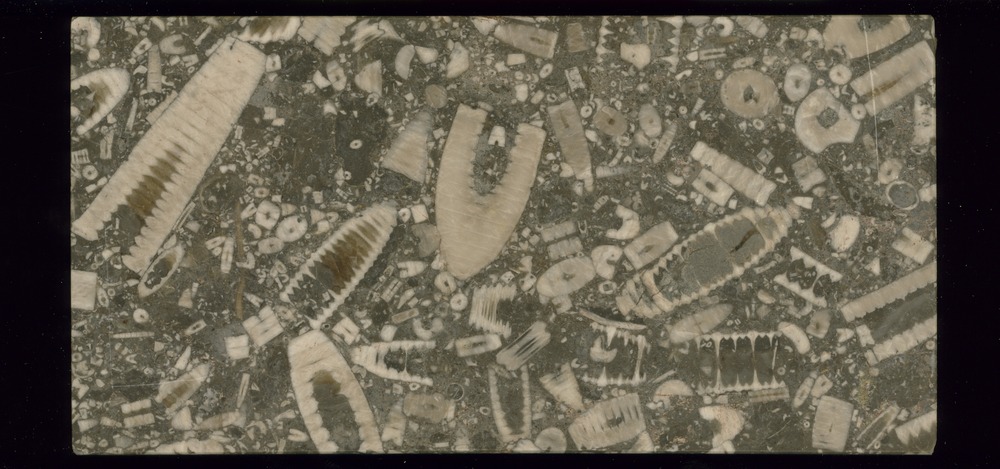
Corsi 285, approx. 145 x 73 x 40 mm, © Oxford University Museum of Natural History
| OUMNH Number: | 285 |
|---|---|
| Name and quarry location: | Derbyshire fossil marble, from Sheldon Moore, Derbyshire, England |
| Geological description: | Carboniferous Limestone; Lower Carboniferous crinoidal limestone with intraclasts, and with suturing of grain contacts. |
| Comments: | The fossilised remains of crinoids (sea lilies) and corals are particularly abundant in Carboniferous Limestone, a geological formation that outcrops in various parts of Britain including Sheldon Moor, in the Derbyshire Peak District. It has been quarried for centuries and used as a building stone, a decorative stone, and now mainly as crushed aggregate. It is rarely quarried for decorative use today. The 6th Duke of Devonshire, who gave Corsi this specimen, was responsible for bringing some of the Derbyshire stone to Rome and there are rare examples of its use in pietre dure work of the early 19th century. |
| References: | Hewitt (2001); Lee (1888) 31-32; Price (2007) 170; Rogers (2008) 64-66; Watson (1916) 13-18 |
| Further information: |
|
| Corsi's classification: | Class 1. Marbles; Section 3. Lumachellas; ii. Italian lumachellas |
|---|---|
| Corsi's text: | 87.53 Lumachella di Sheldon-Moore in Inghilterra |