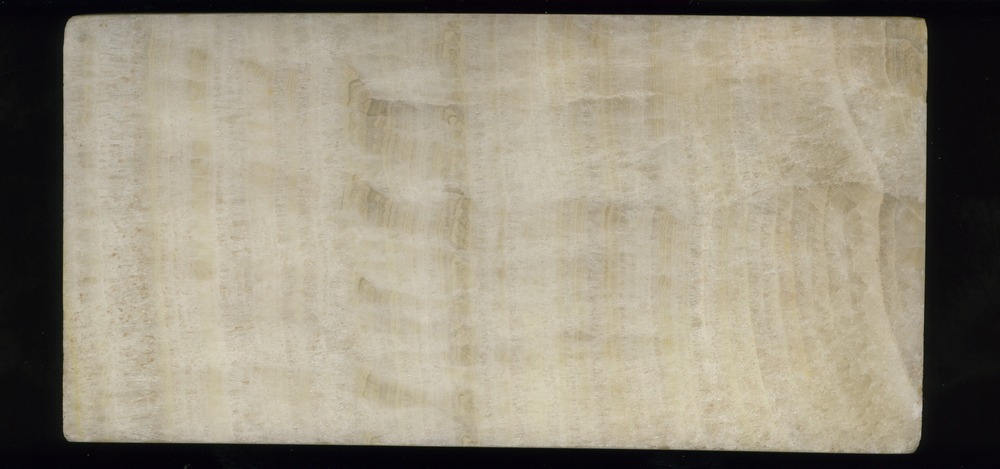
Corsi 304, approx. 145 x 73 x 40 mm, © Oxford University Museum of Natural History
| OUMNH Number: | 304 |
|---|---|
| Name and quarry location: | Alabastro ghiaccione, from Capo Circeo, Latina, Lazio, Italy |
| Geological description: | Compact banded travertine composed of parallel columnar colourless crystals of calcite interbanded with fine grained white calcite. |
| Comments: | It is not clear why Corsi called this stone alabastro fiorito as it lacks the mottled colouration of stones described as 'fiorito' including the true alabastro fiorito (see Corsi no.301). It has been recognised as alabastro ghiaccione. The name 'ghiaccione' means ice, very appropriate for this particularly transparent variety of travertine. The stone was worked in ancient times, as is demonstrated by the sculpture referred to by Corsi in his Catalogo ragionato. The quarries were active in the 16th century and especially in the 18th and early 19th centuries - the time when Corsi was building his collection. |
| References: | Ameti (1693); Bruno (1998); Corsi (1825) 93; Corsi (1845) 131-132; Faramondi (1985) 30-31, 55; Price (2007) 50; Rees (1819) |
| Further information: |
Alabaster-travertine.pdf |
| Corsi's classification: | Class 1. Marbles; Section 4. Concretionary marbles; Species 1. Alabasters; i. Antique alabaster |
|---|---|
| Corsi's text: | 93.11 Alabastro antico. Marmor Alabastrum. Alabastro fiorito... la cava [era al] Tebaide oggi Sayd. |