| OUMNH Number: |
356
|
|---|
| Name and quarry location: |
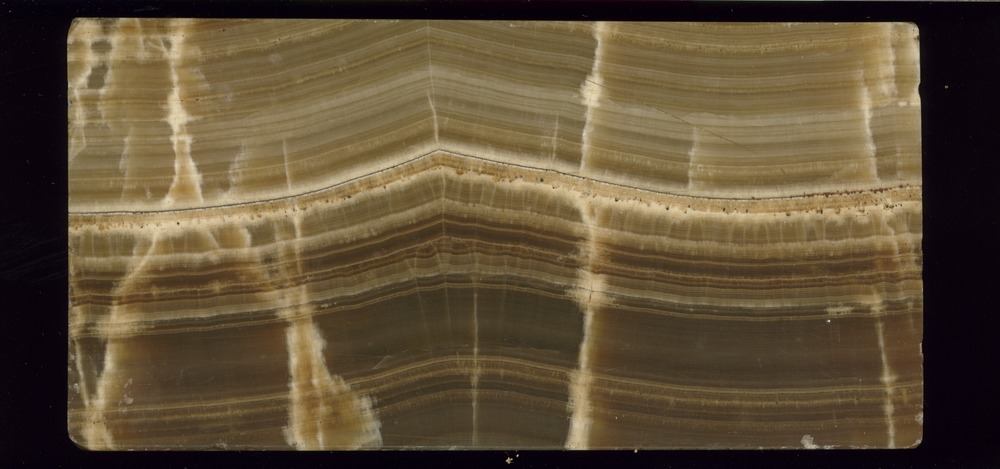
Alabastro a tartaruga, from Montauto, Castelfiorentino, Pisa, Tuscany, Italy or perhaps Iano di Montaione, Florence, Tuscany, Italy
|
|---|
| Geological description: |
Banded compact travertine, composed of very fine acicular calcite crystals. Note white 'fractures' appear to be strings of minute gas inclusions.
|
|---|
| Comments: |
Montauto, in Tuscany, was one of the main sources of Italian compact travertine in the early 19th century, included in a list of ornamental stones and their values in Rome given by Rees (1819). Modern authorities have recognised Corsi's samples as alabastro a tartaruga (alabastro tartarugato), and have said it comes from Iano, outside Montaione in Tuscany. Stone quarried in ancient times was reused by the scalpellini of Rome, who gave it the name 'tartarugata' for its tortoiseshell-like markings. Quarries at Iano were reopened after the second world war for a short time. Which location was the source of these samples remains somewhat uncertain.
|
|---|
| References: |
Borghini (1997) 151; Corsi (1845) 133; Dallan (1969) 46, 62-63; Mielsch (1985) 39, taf.2; Price (2007) 52; Rees (1819)
|
|---|
| Further information: |
Alabaster-travertine.pdf
|
|---|