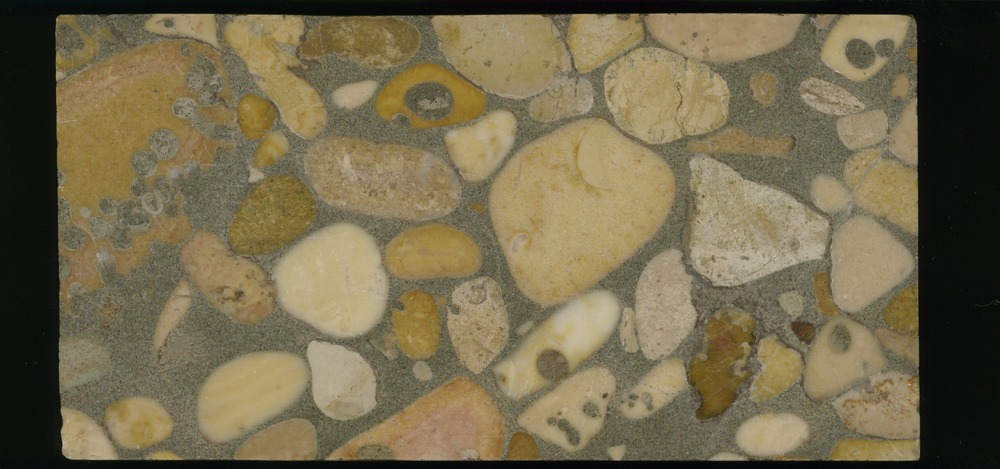
Corsi 680, approx. 145 x 73 x 40 mm, © Oxford University Museum of Natural History
| OUMNH Number: | 680 |
|---|---|
| Name and quarry location: | Breccia frutticolosa, from Bourdeau, Savoie, France |
| Geological description: | Conglomerate of diverse limestone clasts. Clasts have been burrowed by marine bivalves. Matrix is calcareous sandstone with ferromagnesium silicate grains of volcanic origin. |
| Comments: | This is the Breccia frutticolosa of modern authors. It is characterised by the soft sediment borings of marine bivalves, and is a limestone of Miocene age. Corsi’s sample is one of a few examples from the ruins of Rome. The location of the ancient quarries was rediscovered in the 1990s near Bordeau, northwest of Chambéry, although more modern quarrying had obliterated the ancient workings. It was one of the stones used in the 4th century pavement of the baptistry of Notre Dame Cathedral in Grenoble. It is also known as conglomérat de Bordeau. |
| References: | Borghini (1997) 172-173; Dubarry de Lassale (2005) 279-280; Mazeran (1999); Mielsch (1985) 49, taf.11; Price (2007) 146 |
| Further information: |
|
| Corsi's classification: | Class 10. Pudding-stones; i. Antique pudding-stones |
|---|---|
| Corsi's text: | 163.2 [Pudingo antico] |