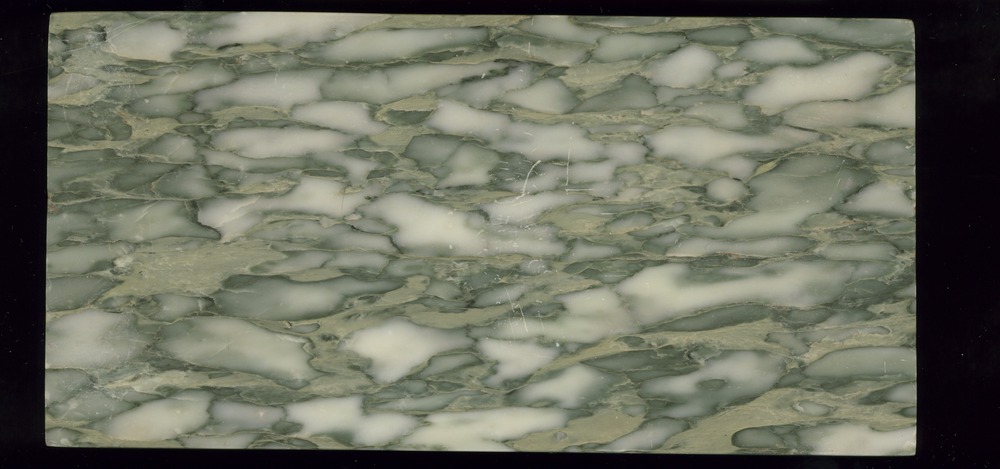
Corsi 93, approx. 145 x 73 x 40 mm, © Oxford University Museum of Natural History
| OUMNH Number: | 93 |
|---|---|
| Name and quarry location: | Campan vert, cipollino verde mandolato, from the Haute Pyrénées (probably Pont de la Taulé), France |
| Geological description: | Weakly metamorphosed Lower Devonian nodular limestone, the white fine-grained calcareous nodules have heavily chloritised rims in a paler green chlorite/calcite groundmass. |
| Comments: | This sample from the ruins of Rome, was obtained by the ancient Romans from the French Pyrenees. It was known to the Italian scalpellini as cipollino verde mandolato. The dark green/pale green/white colouring of this sample suggests that it is very probably from Pont de la Taule, an important source of cipollino mandolato in Roman times. Similar green nodular limestones, often just dark and light green, were obtained from other locations in the Pyrenees, most notably the Campan valley, which was to become the principle source in Medieval times and when the quarries reopened in the 17th century. Known variously as Campan vert, griotte vert, and vert moulin, this was used extensively in the Palace of Versailles, and was widely employed in the decoration of buildings worldwide in the late 19th and early 20th centuries. Quarrying at Espiadet in the Campan valley ceased late in the 20th century. |
| References: | Antonelli (1999); Antonelli (2002a); Borghini (1997) 204-205; Corsi (1845) 97-99; Dubarry de Lassale (2000) 190-191; Mielsch (1985) 58-59, taf.17; Price (2007) 134-135; Rogers (2008) 54-55; Watson (1916) 124, 131-132 |
| Further information: |
|
| Corsi's classification: | Class 1. Marbles; Section 2. Veined marbles; Species 2. Cipollino |
|---|---|
| Corsi's text: | 46.5 Marmo Cipollino. Marmor Carystium. Nel monte Oco vicino alla città di Caristo v'era la cava d'un marmo chiamato Caristio... marmo Euboico poichè Caristo è nell' isola Eubea oggi Negroponte. |