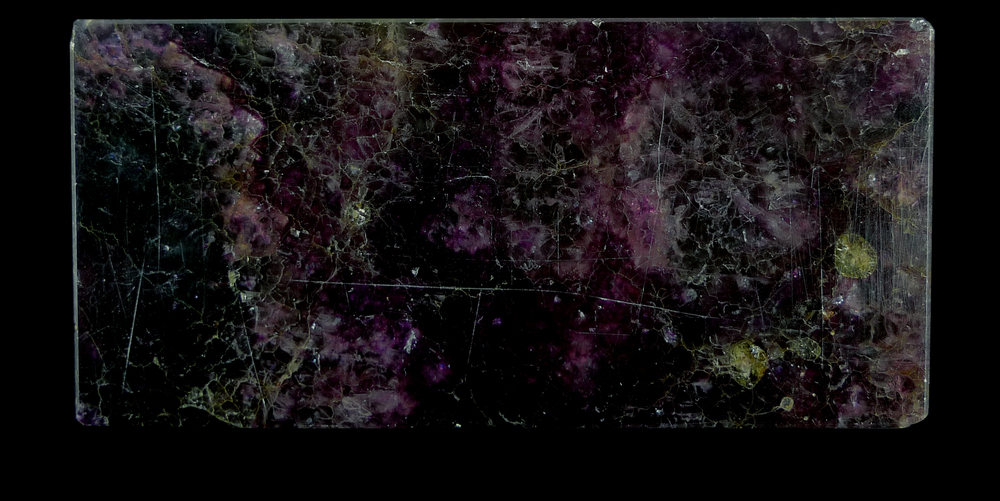
Corsi 543, approx. 145 x 73 x 40 mm, © Oxford University Museum of Natural History
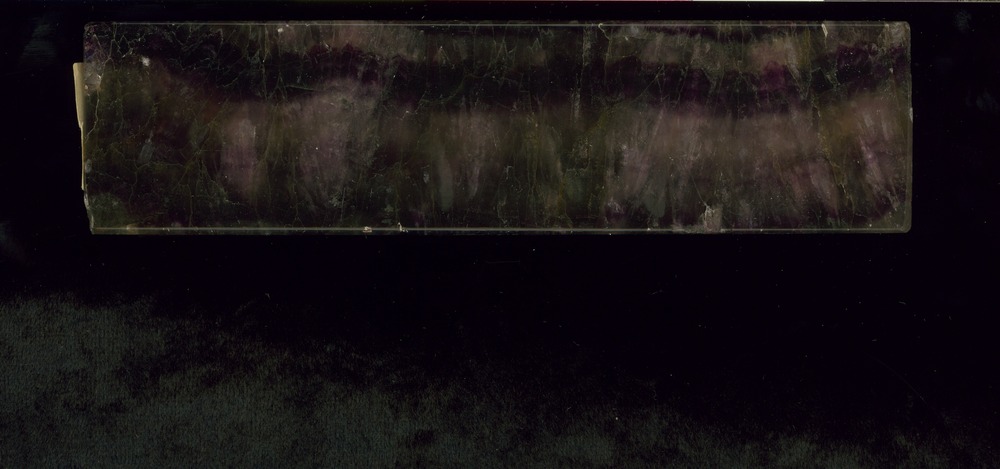
side view of stone 543, approx. 145 x 73 x 40 mm, © Oxford University Museum of Natural History
| OUMNH Number: | 543 |
|---|---|
| Name and quarry location: | Blue John fluorite, from Castleton, Derbyshire, England |
| Geological description: | Hydrothermal vein deposit of colour-zoned purple-blue/colourless fluorite, the variety known as Blue John. |
| Comments: | This specimen was given to Corsi by the 6th Duke of Devonshire following the Duke's visit to see Corsi's collection in 1824. It is a fine example of Blue John, the sides of specimen showing the characteristic colour-banding (also see no. 541). This variety was first discovered at Castleton around 1700, and was mined as an ornamental stone from around 1750 onwards. It was employed with particularly fine effect in the manufacture of decorative ormolu by Matthew Boulton in Birmingham. Small amounts are still extracted today, mainly for jewellery and tourists' souvenirs. For a detailed account of the mining, history and use of Blue John, see Ford (2000). Note that China has produced purple banded fluorite in recent decades for use as a decorative stone, but this usually has some green banding present, a colour not seen in the Derbyshire material. |
| References: | Ford (2000); Price (2007) 266; Webster (1994) 337-341 |
| Further information: |
|
| Corsi's classification: | Class 2. Fluorspars |
|---|---|
| Corsi's text: | 134.6 Altro dello stesso luogo [Spato di Darbyshire]... chiamata bleu Giovanni... trovato unicamente a Castelton |